And we are in it – yes?
But just what is this it that we are in?
I start by considering two versions: subjective & objective. For an objective reality to exist we must: "allow 'that which exists' to be independent of any observer" – and so allow the classic philosophical question: "If a tree falls in the forest and no one is around to hear it, does it make a sound?" to be answered 'yes'. Science is a good go-to with its required predictability and we see that gravity (on earth) is 9.8 N/kg. It just is. Water boils at 100°C. Trees fall and go 'crash!'. This all works well enough but I tend to think more of an objective scaffolding, a lattice of solid-enough 'poles and planks' upon which we can all move about but which is only there so we can work on building the main structure. What we are building is – culture, relationship, memory, language, art – and, perhaps, reality itself? Is gravity true or just a current value to describe the current state? Scaffolding isn't sacred, it's pragmatic. If all conditions are changing perhaps light will wake up one morning and decide to go faster? Or maybe not 'decide' – but just change. Either way this leads me to thoughts on consciousness and the nature of a subjective reality.

The word 'subjective' implies a subject and that subject is surely me. Is my experience a valid apprehension of reality? Do I see (hear, taste, touch, smell, think) a precise version of my life – my experience? In brief I would say no. The instrument(s) of our perception and apperception are so influenced by and dependent on an incredibly wide array of variables that any conclusion I might make is dubious. In science much effort is made to isolate the item being observed but this is effectively impossible. Nature is what we study and it is a complex, inter-dependent, inter-related system which cannot be broken down into parts. There is also the problem of the 'observer effect' (see: Heisenberg's uncertainty principle and the Hawthorne effect) where the observer's, my presence, affects outcomes. And yet we do manage to tease out repeatable data – this gadget on which I am typing being one awesome example. The point here being that while we are limited in our ability to see the full extent, the true nature, of what we see we are not totally trapped by these limitations. Note: I will use 'see' as an inclusive for all the senses, including the mind... which includes many things; seeing can = understanding (if you see what I mean?). Before I explore ways to work with these limitations I would like to give a little more time to consider the nature of those: solid-enough 'poles and planks' – the scaffolding.
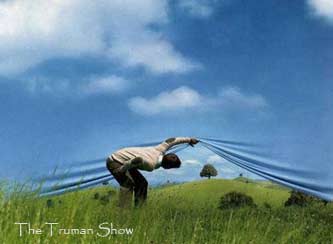
There are various scientific and philosophical approaches to defining reality. I have a tech background but will resist the temptation to go too far down this rabbit hole. Nevertheless some thoughts might be helpful/interesting. In quantum physics 'solid' is considered more in relation to events, interactions, and the probabilistic nature of 'things'. What is observed are behaviours like wave-particle duality, quantisation, superposition, and entanglement. And I am sure that all makes sense to you? I just read it in a book :)) – but the inclination definitely deviates from the Newtonian model of 'solid' being like a bunch of billiard balls bouncing around. Particle physics has substance as mostly space with only the electromagnetic forces preventing things passing through other things; the solidity we perceive in everyday objects is primarily an illusion. And there is 'idealism' which posits that reality is fundamentally mental, spiritual, or idea-based rather than material. Read: Plato, Kant, and Hegel. And there are various versions of idealism: subjective, objective, transcendental, absolute... Another interesting perspective (and, wow, there are many) is from Donald Hoffman proposing that the fundamental nature of reality consists of 'conscious agents' interacting with each other; that consciousness – not space, time, or matter – is the most fundamental component of the universe. And in, or through a mixture of these speculations... ideas emerge and are developed into practical, every day 'solid things' in our lives. For example, isn't AI pretty out-there, space-age, futuristic, fantasy stuff? Where did that come from? It has a functional reality. To be able to see the world in a way that is not bound by our 'normal' default is something that we are all capable of and it is this outside-the-box seeing that can allow us to evolve a clear understanding, a focussed vision of what we see that reveals a more complete truth.
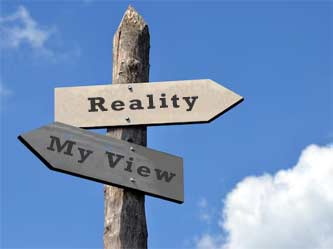
Still, our subjective, experiential reality is seriously influenced by an incredibly wide array of variables; memories, perceptions, etc.. Santa Claus was a significant part of my reality – and now my reality is different. It was so real, so true. What changed? Do you believe in ghosts, broken mirrors, rabbit's feet, four-leaf clovers... etc.? These are relatively simple examples (of delusion?) and we can, must!, dig a little deeper and explore the conditioning that creates our reality and what triggers our anxiety, fear, anger, sadness, greed, etc., and see that so often the reaction is irrational. I see someone who looks like the school-yard bully and I get afraid... even knowing he died some years ago.
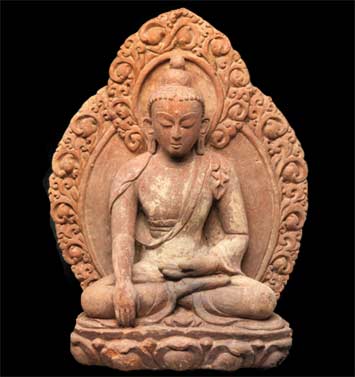
Let's further explore the relationship between subjective and objective experience; moving on from Schrödinger's cat and all that to look at the main show – you! It is our personal access to truth, our freedom, our actual, here-and-now life which is what matters. The fear is the subjective; it is me that is afraid. And then I ask: "who is it that is aware of the fear?" This 'who' is the objective, or perhaps objectivity – and it is not afraid, it simply knows. It is a seeming paradox when I talk about 'me and my body' and wonder who this me is that has a body? The resolution is about being aware of and neutrally awake to the presence of conditions. The distinction between this seeming duality is one of identity and ownership and it is the Buddha's key to freedom; the teaching of non-self, anattā. We can use the objective-observer, awareness itself, as a silent resting point to explore projected, fabricated and conditioned realities. And, with practice, we can see the integrated whole. Reality is homogenous.
Eg. read: Thich Nhat Hanh: Interbeing + holism, idealism, monism, relationism, emergentism... and that dang cat keeps sneaking back in.
Consider a gymnasium analogy where there is no single exercise to arrive at full fitness. In the same way the Buddha's teaching is a lattice of many 'poles and planks' built to promote a state of fitness – a framework for reality. The heart of this scaffolding is the Four Noble Truths at the end of which we have the Eight-fold path, often represented as a wheel; a completed circle with the section of the rim and the central hub collectively holding the spokes firmly in place. Detaching a few of those spokes let's consider the faculty of seeing – in Pali this is 'sati' = awareness, mindfulness, presence, recollection, attention; the 7th spoke. Awareness is my working preference. There is another phrase/couplet that usefully tags along with sati: sati-sampajañña = awareness and clear comprehension. The 8th spoke is 'samadhi' = concentration. Sati and samadhi work together; sati like a camera (that sees) and samadhi like the gimbal that it sits in to keep it steady. Sati allows us to become aware of, to perceive 'reality', and sati-sampajañña allows us to understand our encounter; and this happens more accurately through the stability that samadhi offers. A combined training in awareness and concentration brings a calm clarity to the mind. There is a spacious brightness that illuminates our mental process and gives rise to comprehension, discernment, wisdom. Over time this, along with the other spokes, reveals an increasing number of anomalies between our default, habitual view of reality and what is actually present to be seen; the truth... undisguised, naked, free of conditioned distortion. This is true freedom. The Bahiya Sutta succinctly describes this. Excerpt, the Buddha speaking...
When Bahiya, for you in the seen is merely what is seen; in the heard will be merely what is heard; in the sensed will be merely what is sensed; in the cognised will be merely what is cognised, then Bahiya you will not be 'with that'. When Bahiya you are not 'with that', then Bahiya you will not be 'in that'. When, Bahiya, you are not 'in that', then Bahiya you will be neither here nor beyond nor in between the two. Just this is the end of suffering.
Journey's end, the end of suffering, nibbāna, enlightenment, the deathless. And it is a journey, a training of the mind. Meditation, the cultivation of the Buddha's teaching.
The first spoke is sammā diṭṭhi = right view, clear seeing, correct understanding. It is the inception of the journey and warrants a separate post – later.
A similar term to sati is appamāda = heedfulness, non-negligence, thoughtfulness, carefulness, conscientiousness, watchfulness. Its importance is very graphically shown in Dhammapada: 21
Heedfulness is the path to the deathless,
heedlessness is the path to death.
The heedful do not die,
the heedless are as if already dead.
The Appamāda Sutta has appamāda as one quality that secures all benefits.
And lastly, the final words of the Buddha:
Khaya-vaya-dhammā saṅkhārā,
Appamādena sampādethāti.
All conditions are subject to decay.
Realise completion through heedfulness.