Meditation... What is it?
How do we do it?
And why?
There is no end of information available and this is simply my perspective from an exploration of 40+ years; 33 of those as a monk. So, what is it? In a word I would say 'training' – and my dictionary defines this as: "An activity leading to skilled behaviour." with a few synonyms being: "teaching, education, learning". To be clear, meditation is not passive, it is active, it is something we do. We are engaging this thing called 'me' with the intention of leading it toward some kind of (new) behaviour. The closest word to meditation in the Pāli Canon is bhāvanā = "cultivation, development, producing, in the sense of 'calling into existence'". There is also pattipada = path of practice.
There are many forms of meditation and I will first make the distinction between transformative and transcendent. The first is working with your character, your personality, your conditioning, the 'stuff' that gives rise to and constitutes your life experience, with a view to transforming it into some-thing better. You have anger issues, you drink too much, your language is dubious... etc. – the list might be quite long – and you want to 'get it sorted'. This sorting, this work, is transformative. Transcendent practices incline to the religious, the spiritual, aiming to not be bound in or dictated to by conditions. Transformation can be thought of as self-improvement while transcendence explores the actual nature of self. The two are related and practised in tandem.
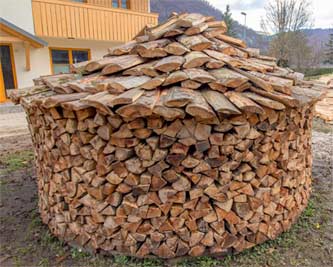
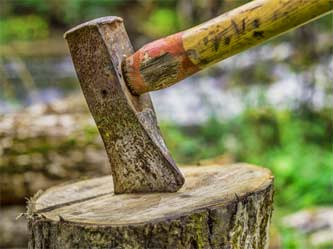
I toyed with the idea of titling this simply 'fire' as, for small screens, it would be four less letters on the menu. But it is in fact the fuel that is at the heart of this business. And 'this business' is about keeping the engine running, the fire burning, the wheels turning. The burning consumption that seems to drive much of life. But we'll get back to that. Winter is not far away here in New Zealand and one of my projects is firewood; the sourcing, cutting, splitting, transporting and stacking, ready for the colder months. It is quite an operation.
There are a large number of wilding pines on the monastery property and while the wood doesn't burn so hot it is certainly plentiful. The trees are felled by various people (not monks) and the work of dissembling an entire tree is probably the most arduous, complex and dangerous part of the whole process. The trunk rarely falls flat to the earth so there are several tonnes of wood suspended in the air resting on downward branches spiked into the ground. Determining which branches are carrying the load is the most crucial task and being crushed by a collapsing tree is best to be avoided. An 18" chainsaw weighs about 6kg with a considerable power output. The chain can cut limbs (excuse the pun), it can grab and pull you forward, it can kick back and take off your face, or at least give you a nasty fright in that direction.
The following text is from my Q&A booklet and was sent to me by a friend with a question.
"On a deeper level meditation works by investigating and understanding the nature of the mind itself. It is seen as a condition in nature, devoid of any solid personality or lasting quality. When this insight arises one can be peaceful with the most horrific mind states; one doesn’t take it all so personally".
Their question...
"How do I encourage a deeper level of concentration so this insight can arise?"
My reply was written at Vimutti monastery. I had arranged to stay there over Easter weekend as part of a northern wandering and the time coincided with the arrival of cyclone Tam so there was time to spare and the text ended up longer than I had originally planned.
...
Insight is seeing into, understanding, having knowledge of dhamma. Concentration is defined canonically as the jhanas and they are usually regarded as states of absorption. The definition of dhamma-terms brings many opinions, which I won't discuss, but I would very much recommend reading this analysis of jhana by Ayasama Kumara. 
This post follows relatively soon after the previous one. Building things with words, writing, is something I enjoy but find arriving at a finished product awkwardly protracted. I regularly recall the suggestion of Roald Dahl to budding authors: "Sit down at a desk with a pencil and paper". So here I am, with the tech-adjusted equivalent, practicing. Part of the quick follow-on is the ease of having a laptop with an external monitor, as opposed to my on-the-road phone set up, as well as having a chair and desk. Luxury! Practice makes perfect... and between now and the Pulitzer nomination I hope you can bear with my experimentation. I am at a life-transition point, (a kind of) retirement, and the question is: 'what do I do now?' This blog is a part of the ongoing exploration. I have a few ideas regarding structure and content and... the digital world presents an incredible array of possible directions with my overall inclination toward connection. Let's consider the obstacle to that first: isolation.
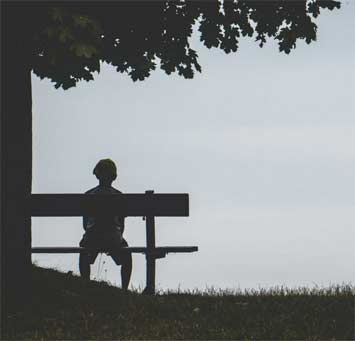
People are experiencing more loneliness and social isolation. A recent Gallup poll shows that nearly 1 in 4 adults feel lonely. A 2023 report by the US Surgeon General says that approximately 50 percent of adults feel lonely. A study by Cigna (global health insurance) has the age group 18-22 as the loneliest with 79% reporting feelings of loneliness. The generally suggested causes - pandemic, remote working, social anxiety, self esteem, media, etc. - are part of a community drift, one that I see closely tied to issues of identity.
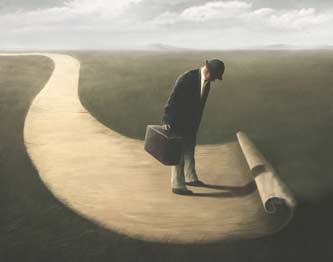
I have just ended five weeks of wandering in the South Island. You can read a brief log and view some photos off the menu above. In the middle of this time I ended my 72nd year. Some of those days ended with a cup of tea, some ended with a spectacular sunset; some with both. But each and every one ended. The cup of tea (sadly) ended, as did the sunset. And I incline here to a wee musing on time and place, when and where, birth and death and... the 'who.' Not the '70s band, or the doctor but the 'you who' - that exists in space and time, sitting (here, now) reading this. Or are you?
First a few speculative considerations. Does time, and or 'stuff', actually exist? The present moment is singular and it is our mind that concatenates perception (interpretation) and memory (storage) to form a sense of continuity; joining the dots to form a line. Is this presentism, or idealism - or is it solipsism? Compare it with eternalism. There is observable change anicca but do things exist outside of my mind? If you haven't seen the Matrix movie? you should. The block universe model (google it) has four-dimensional space-time with every event having its own coordinates in space-time and all moments equally real and existing simultaneously. And we have Heisenberg's uncertainty principle, Schrodinger's cat, the multiverse theory, etc.